Inverter vs. PCS: What's the Actual Difference?

Say you're adding battery storage to a commercial solar project. The battery capacity looks right, the inverter is sized correctly on paper, and the design appears straightforward — until you realize the equipment selected was designed for solar generation, not energy storage. The issue is not that the inverter is a bad product. It simply was not designed to manage the way a battery system operates.

This confusion is common because an inverter and a power conversion system (PCS) perform similar-looking tasks on a technical diagram. Both convert electrical energy between DC and AC, but they are designed around different purposes. A solar inverter helps move electricity from a generation source into the electrical system, while a PCS acts as the power conversion and control interface that allows a battery to store, release, and manage energy when the system needs it.

Think of a regular solar inverter as a one-way street. Its primary role is to convert DC power generated by solar panels into AC power for your home or the grid. Active power normally moves in one direction — from the solar source, through the inverter, and toward the electrical system. This design works well because solar generation follows the availability of sunlight: when the sun is producing energy, the inverter converts that energy into usable electricity.

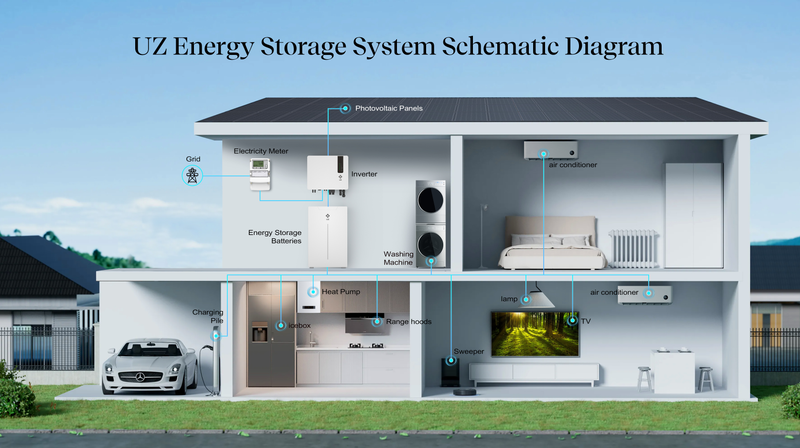
A battery storage system follows a different logic. A battery does not generate electricity; it stores energy and releases it later based on system requirements. During the day, excess solar power can be stored in the battery. Later, that stored energy can be used when solar generation decreases, electricity demand increases, or backup power is needed. Solar generation follows availability. Storage follows demand. The equipment that connects these two different operating patterns is the PCS.

A PCS is designed as a bidirectional power conversion interface between the battery and the AC system. It can convert AC power into DC power to charge the battery, or convert stored DC energy back into AC power when the system needs it. More importantly, it is designed to actively manage energy movement rather than simply convert electricity. The PCS executes commands from the energy management system (EMS), which coordinates overall system operation, while operating within the voltage, current, and temperature limits communicated by the battery management system (BMS).

The difference is not only about whether power can flow in two directions. A storage system requires equipment that can respond to changing conditions and system requirements. A solar inverter is mainly designed to maximize energy production from a renewable source, using technologies such as MPPT (maximum power point tracking) to capture the available power from solar panels. A PCS is designed around the needs of an energy storage system, where charging, discharging, and power control must happen according to the role the battery plays in the wider energy system.

This is why the idea of “just connecting a battery to an existing solar inverter” can create challenges in retrofit projects. Conventional PV inverters are generally not designed to directly manage battery charging and discharging behavior. Solar panels and batteries may both provide DC power, but they behave differently: solar output changes mainly with sunlight conditions, while batteries actively absorb and release energy based on system requirements. Some hybrid inverters combine solar and battery functions for smaller residential applications. However, commercial and utility-scale storage systems usually rely on dedicated PCS equipment because the battery needs a dedicated interface for controlled bidirectional operation.

The architecture makes the difference clear:

A solar-only system:

Solar panels → PV inverter → AC loads / Grid

A storage system:

Battery → PCS → AC loads / Grid

with the EMS coordinating system operation and the BMS monitoring battery conditions and maintaining safety boundaries.

An inverter and a PCS may look similar from the outside, but they serve different roles in an energy system. An inverter converts electricity from a generation source, while a PCS enables controlled energy exchange between a battery and the wider electrical system.