On-Grid, Off-Grid, and Hybrid: Choosing the Right Inverter Type


The easiest way to choose the wrong inverter is to treat on-grid, off-grid, and hybrid as three levels of the same product. They are better understood as answers to a more basic question: what role is the utility grid supposed to play? A system connected to a reliable grid can lean on that grid for both an electrical reference and energy when local generation is short. A system expected to keep supplying loads during an outage has to maintain a local supply after the utility disappears. A site with no utility connection has to maintain its own local supply as normal operation. Those are different operating jobs, and the inverter category should follow the job rather than the label.
For the basic residential case, an on-grid inverter normally operates with the utility present. The U.S. Department of Energy describes traditional grid-following inverters as using an outside grid signal as the reference for the AC waveform they produce. During normal operation, rooftop solar can serve local demand, while the home remains connected to the grid to balance supply and load when solar production is insufficient. When generation exceeds local use, the excess can be sent back to the grid. (energy.gov) Whether that exported energy earns a payment or bill credit depends on the policies and practices of the local utility and state. (energy.gov) Household inverters can ride through limited voltage or frequency disturbances, but they disconnect when grid conditions move far enough outside their allowed range. That is why panels producing power at noon do not, by themselves, guarantee usable electricity during a blackout. (energy.gov)

Backup changes the operating job

Add a requirement that the refrigerator, lights, internet connection, or other essential loads must continue running during a utility outage, and the selection problem changes. The site is still grid-connected most of the time, but the inverter system now has to support a second state. With the utility available, it operates alongside the grid. When the utility is unavailable, the backed-up part of the installation has to operate as an intentional island, separated from the failed grid and supplied from local resources. DOE describes residential solar-plus-storage systems that detect loss of grid power, switch into islanded operation, and reconnect after utility service returns. (energy.gov)
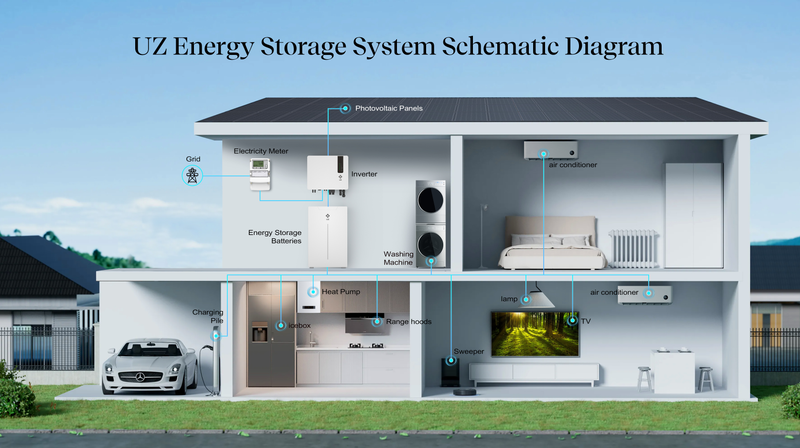
In residential solar, this is often where hybrid inverters enter the conversation because they can integrate battery operation with grid-connected operation and, in some designs, backup. The word hybrid still does not tell you what the building will experience during a blackout. One product may provide only a dedicated backup output; another may support a much broader backed-up circuit. Fronius provides a concrete example within one inverter family: its PV Point supplies selected single-phase loads, while its Full Backup arrangement is intended for the whole household and uses a hybrid inverter, battery, and backup switching equipment. The useful lesson is not the brand distinction. It is that backup capability belongs to the configured system, not to the word hybrid alone. (fronius.com)
That makes the load requirement more useful than the product label. Keeping a refrigerator, a few lights, and communications alive is a different job from keeping pumps, cooking equipment, air conditioning, or most household circuits available. Those expectations affect how much power must be available in backup mode and which loads are placed on the backed-up side. Battery energy then affects how long that supply can continue. At this stage, the buyer does not need to design the transfer hardware or work through battery protocols; those are later checks. The first decision is whether the inverter system can enter the operating mode the site actually requires.

Off-grid is normal operation without the utility

An off-grid site starts from a different premise: there is no utility to return to. A battery-based off-grid system therefore cannot assume that the utility will provide the local AC reference; something inside the system has to establish and maintain that local network as part of everyday operation. SMA’s Sunny Island is one example: its battery inverter forms the stand-alone grid as a voltage source and regulates the balance between energy supplied and energy used. PV can feed that local grid, the battery can absorb or supply energy, and a generator can be added as another source. (manuals.sma.de)
The absence of a utility changes the consequence of every energy shortfall. In a normal grid-connected home, a cloudy period or a sudden rise in demand can often be covered by importing more electricity. In an off-grid system, the shortfall has to be met by local generation, stored energy, another local source such as a generator, or by reducing demand. An off-grid design therefore has to solve two problems that a normal grid-connected home can hand back to the utility: maintaining the local electrical supply and covering the energy balance over time. Adding a battery to a conventional on-grid inverter does not, by itself, solve either one.
The category choice can now be made without turning the three terms into a feature ranking. If the utility is available and losing power during an outage is acceptable, a conventional on-grid system may satisfy the operating requirement. If the utility is part of normal operation but some loads must continue when it fails, the system needs verified backup or islanded capability; a hybrid inverter is one common route, but its actual backup mode has to match the load requirement. If no utility is available for normal operation, the site needs an off-grid architecture capable of maintaining the local supply.
Only after that choice do details such as transfer equipment, battery compatibility, and coupling architecture become useful filters between specific products. Starting with those specifications too early makes very different systems look comparable because their brochures share the same words. Start instead with three operating conditions: what the inverter must do while the grid is present, what it must do when the grid is unavailable, and whether the site has a grid to rely on at all. That answer narrows the inverter type before the product comparison begins.