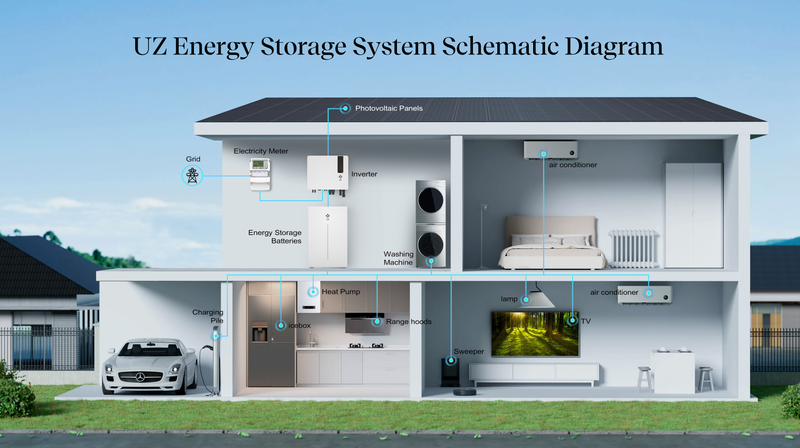
Battery storage is becoming an increasingly important part of the U.S. electricity system. As renewable generation expands and electricity demand evolves, energy storage is helping shift electricity from periods of high generation to hours when it is more valuable or needed. At the same time, changing market conditions, investment incentives and operating requirements are influencing how energy storage projects are designed, integrated and operated.
According to the U.S. Energy Information Administration (EIA), operational utility-scale battery storage capacity in the United States reached nearly 52 GW by the end of June 2026, following the addition of 8.3 GW during the first half of the year. This reflects the continued expansion of battery storage across the U.S. electricity system. EIA: Battery Storage Capacity in the United States.
The market spans utility-scale, residential and community, commercial and industrial (CCI) applications, although quarterly trends vary across segments. According to the U.S. Energy Storage Monitor published by Wood Mackenzie and the American Clean Power Association (ACP), the United States installed 5.4 GW / 18.9 GWh of battery storage in Q2 2026. Utility-scale projects accounted for 4.7 GW, while residential installations added 676 MW and the CCI segment contributed 48 MW. The average duration of installed systems increased from 2.8 hours to 3.5 hours year over year. Wood Mackenzie and ACP: Q2 2026 U.S. Energy Storage Monitor.
These developments provide an important backdrop for RE+ 2026, taking place November 16--19 at the Las Vegas Convention Center, with the exhibition running November 17--19. UZ Energy will meet industry professionals at Booth N3328, presenting its residential and commercial energy storage portfolio and discussing opportunities for cooperation in the U.S. market.
U.S. Energy Storage Market Trends: From Capacity Growth to Operational Value
The expansion of battery storage is also changing how renewable energy projects are developed.
According to the EIA, more than 16% of new utility-scale solar capacity added in the United States through September 2026 was co-located with operational battery storage, compared with approximately 2% in 2017. Based on developers' reported plans for the remaining months of 2026, this share could reach 19%. EIA: Solar and Battery Storage Co-location.
Co-located storage allows project operators to direct solar generation either to the grid or into batteries, depending on electricity prices and operating requirements. This provides greater flexibility in when electricity is delivered and how renewable generation is used.
However, increasing installed capacity does not automatically translate into higher revenue per unit of storage.
The California Independent System Operator (CAISO) provides a useful example. Its Department of Market Monitoring reported that battery storage capacity in its market footprint reached 25.7 GW at the end of 2025, a 42% increase from the previous year. Over the same period, average net market revenue for batteries in the CAISO balancing area declined from approximately US$53/kW-year in 2024 to US$45/kW-year in 2025. CAISO: 2025 Special Report on Battery Storage.
These figures illustrate an important distinction: expanding storage deployment and improving project economics are not the same thing. Revenue depends on market conditions, dispatch opportunities, system availability, operating constraints and the services a battery can provide. The CAISO figures are market-level revenue indicators, not a measure of the full investment return of an individual project.
For developers and system integrators, equipment selection therefore needs to consider more than rated power and energy capacity. Charging and discharging capabilities, usable energy, operating duration, system integration and battery management all influence how effectively a project can perform its intended role.
The different growth patterns across market segments also point to varying project requirements. Utility-scale installations increasingly address grid-level flexibility and longer-duration needs, while residential customers evaluate storage around household consumption, backup requirements and solar self-consumption. C&I projects, in turn, must account for site load profiles, operating schedules and the relationship between energy costs and demand.
U.S. Energy Storage Investment Incentives and Market Participation
Federal investment incentives remain an important consideration in U.S. energy storage development.
Section 48E, the Clean Electricity Investment Credit, includes qualifying energy storage technology. The base investment credit is 6% of qualified investment, potentially increasing to 30% when applicable prevailing wage and registered apprenticeship requirements are met. Additional incentives may apply to qualifying projects under domestic content and energy community provisions. Eligibility and credit amounts depend on applicable tax rules and project circumstances. IRS: Clean Electricity Investment Credit.
Beyond investment support, access to electricity markets also influences the commercial potential of energy storage.
FERC Order No. 841 established a framework for electric storage resources to participate in wholesale markets operated by regional transmission organizations (RTOs) and independent system operators (ISOs). It enables technically qualified resources to provide energy, capacity where applicable, and ancillary services under relevant market rules. FERC: Order No. 841.
Separately, FERC Order No. 2222 establishes a framework for aggregations of distributed energy resources, including battery storage and rooftop solar, to participate in organized wholesale electricity markets. By combining smaller resources into aggregated portfolios, qualified distributed assets can meet applicable market participation requirements, subject to regional implementation and market rules. FERC: Order No. 2222.
Together, these developments highlight how energy storage project decisions extend beyond equipment procurement. Investment conditions, market participation rules, system configuration and operating strategies all influence how a battery is integrated and used.
UZ Energy Residential Battery Packs and C&I Energy Storage Solutions
UZ Energy develops energy storage solutions for residential and commercial and industrial applications. As part of SES AI Corporation, a U.S.-headquartered battery technology company, UZ combines its energy storage engineering experience with access to battery intelligence capabilities.
Its residential portfolio includes three battery packs: IG-16K-U (16.0 kWh rated energy), PLPA-L1-10K2-U (10.24 kWh rated energy) and Model A (L051100-B) (5.12 kWh rated energy). These products address different residential storage requirements and support integration with compatible inverter systems.
For commercial and industrial applications, UZ Energy offers the PMU-A125K-261L-U, a 125 kW / 261.25 kWh all-in-one C&I energy storage system designed for the North American market. The outdoor cabinet integrates battery storage, power conversion and battery management, with liquid cooling and layered safety protection.
Alongside its energy storage portfolio, UZ Energy also integrates SES AI SoX™ EdgeBox with compatible storage systems. Powered by Battery Edge Intelligence (BEI), EdgeBox combines physics-enhanced AI models, historical operating data and real-time battery information to support SOC estimation, targeted cell balancing, power coordination across parallel battery packs, and cell-level diagnostics. BEI calculates cell-level balancing requirements for execution by the BMS and coordinates operating limits for application by compatible PCS units. These capabilities provide additional insight into battery conditions and support more informed operating and maintenance decisions.
Together, UZ Energy's residential battery packs, integrated C&I solutions and battery intelligence capabilities address different requirements across the energy storage market. Explore more about UZ Energy and its industry events.
Meet UZ Energy at RE+ 2026 in Las Vegas
As the U.S. energy storage market continues to evolve, UZ Energy looks forward to meeting industry professionals and exploring opportunities for cooperation across residential and commercial energy storage applications.
At RE+ 2026, the UZ Energy team welcomes distributors, installers, EPC contractors, project developers and technology partners to discuss battery solutions, system integration and the evolving requirements of energy storage projects.
RE+ 2026 Event Details
- Event: RE+ 2026
- Date: November 17--19, 2026 (Exhibition)
- Venue: Las Vegas Convention Center
- Address: 3150 Paradise Road, Las Vegas, NV 89109, USA
- Booth: N3328
Visit UZ Energy at Booth N3328 to explore its residential battery packs, C&I energy storage solutions and battery intelligence capabilities.
Connect with UZ Energy in Las Vegas and explore what's next for energy storage.