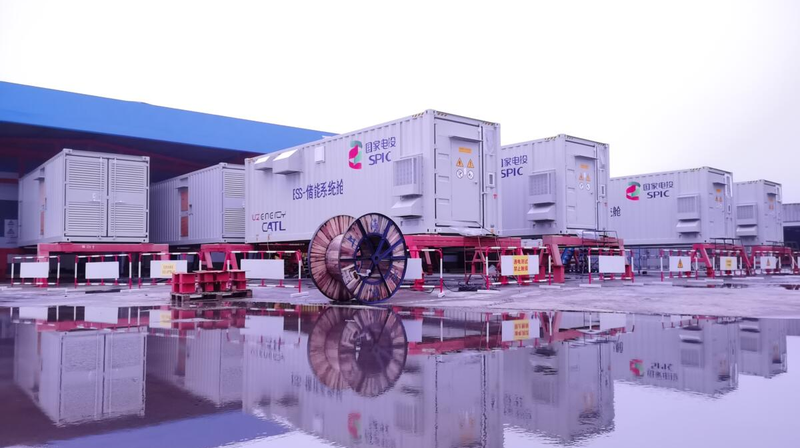
Battery storage is changing some Chilean solar contracts by separating the time of generation from the time of delivery. Multi-hour systems can charge during solar-production periods and support contracted nighttime blocks, but the project must preserve usable energy and power across the full agreement term.
Multi-hour batteries are separating when solar power is generated from when electricity is delivered, changing how some utility-scale projects are designed, contracted and operated.
Chile’s latest solar-plus-storage projects are making a commercial change increasingly visible. ContourGlobal has begun construction of Los Maitenes in the O’Higgins region, combining 131 MWp of solar generation with a 90 MW/360 MWh battery system. Commercial operation is scheduled by the end of 2027. The project has a long-term power purchase agreement covering daytime and nighttime delivery blocks, while part of its capacity will remain available for merchant-market opportunities. (Energy-Storage.News)
Recent contracts from Grenergy make the shift even clearer. On June 30, the company announced a 15-year agreement in Chile for 1 TWh of electricity per year during non-solar hours, supplied through its Elena battery project. The following day, it launched a reverse auction for 1.5 TWh of annual supply from solar and storage assets in northern and central Chile. The proposed volume was divided into 960 GWh of battery-stored electricity for nighttime delivery and 540 GWh of photovoltaic generation for daytime delivery. The contract design therefore treats delivery time as an explicit feature of the electricity being sold. (Grenergy — Nighttime PPA; Grenergy — Reverse Auction)
These arrangements do not mean that Chile’s entire solar market has adopted a new model. They do show that some utility-scale projects are moving beyond contracts that simply follow the solar production curve. Storage gives developers the option to offer electricity according to a delivery schedule that differs from the hours in which it was originally generated.
Why time matters in Chile
The economics behind this development are closely tied to the shape of Chile’s power system. Solar and wind accounted for about 38% of electricity injected into the national system in 2025, according to the Coordinador Eléctrico Nacional. During some hours of the year, the two technologies supplied as much as 79% of demand. At the same time, Chile’s Ministry of Energy reports that more than 6,000 GWh of renewable generation was curtailed in 2025 because of transmission bottlenecks. (Coordinador Eléctrico Nacional; Ministerio de Energía)
That combination creates both a network constraint and a timing problem. Solar production is concentrated during daylight hours, while demand and transmission availability do not necessarily align with that production profile. Adding solar capacity alone does not change when that electricity reaches the system.
Storage introduces another degree of flexibility. A battery can charge while solar generation is available and discharge several hours later, allowing the project’s delivery profile to differ from its production profile. It cannot remove the need for transmission investment. Energy shifted across time still has to move through the network, and storage in one location cannot solve congestion elsewhere. But it can give a project greater control over when stored electricity becomes available to the market.
ContourGlobal’s operating projects show how that works in practice. Quillagua combines 221 MWp of solar with 1.2 GWh of battery storage. The company reports that the plant can deliver 200 MW for up to 6.2 hours after sunset under a long-term overnight power purchase agreement. (ContourGlobal — Quillagua)
Víctor Jara provides a second operating example. The project combines 231 MWp of photovoltaic capacity with 1.3 GWh of battery storage and can deliver up to 200 MW for 6.5 hours after sunset. Commercial operation began in March 2026, and the project includes a 15-year night-only PPA with Copec EMOAC. (ContourGlobal — Víctor Jara; ContourGlobal — BESS Portfolio)
The duration of these systems has a specific commercial purpose. A six-hour battery is not automatically superior to a two- or four-hour system; duration becomes valuable when it matches the work the project is expected to perform. At Quillagua and Víctor Jara, multi-hour storage extends delivery well beyond sunset and supports contracts whose timing differs materially from the underlying solar generation profile.
That is a more useful way to read Chile’s multi-hour BESS development than simply comparing project sizes. The question is whether storage duration, power rating and operating strategy fit the period over which electricity needs to be delivered.
Contracts are becoming more time-specific
Grenergy provides an independent set of examples. Its June nighttime PPA covers 1 TWh annually for 15 years and applies specifically to non-solar hours. The agreement is scheduled to take effect between July and October 2026. (Grenergy)
Its July reverse auction makes the timing distinction unusually explicit. Of the proposed 1.5 TWh of annual supply, 960 GWh would come from battery-stored electricity injected during nighttime periods and 540 GWh from photovoltaic production, with supply scheduled from 2028. (Grenergy)
The auction has to be described according to its actual status. Grenergy launched the process and invited applications through July 22, but a procurement launch is not an awarded PPA. As of August 7, 2026, the company’s public news and securities-disclosure pages do not show an announced award for the advertised volume. Its significance at this stage lies in the product offered to potential buyers: daytime photovoltaic generation and nighttime battery supply were separated into distinct delivery periods. (Grenergy News; Grenergy CNMV Communications)
Grenergy has also signed a 12-year hybrid PPA for Algarrobal, the fifth phase of Oasis de Atacama. The agreement covers 350 GWh per year from a planned project with 242 MW of solar and 1,412 MWh of storage. The project is expected to begin operations in the third quarter of 2027, while contracted supply is scheduled to begin on January 1, 2028. (Grenergy)
Taken together, these contracts show several ways developers are using storage to alter the relationship between generation and delivery. They do not establish one standard Chilean PPA model, but they make timing an increasingly visible part of how some solar-plus-storage projects are commercialised.
Project financing offers a separate measure of market maturity. In February, Grenergy secured $355 million of senior non-recourse financing for Gran Teno, Tamango and Planchón. Together, the three projects represent 398 MW of solar capacity and about 1.4 GWh of storage. The financing supports the hybridisation of Gran Teno and Tamango and construction of the Planchón hybrid project. (Grenergy)
In May, Grenergy secured another $268 million of senior non-recourse financing for Monte Águila, a Central Oasis project with 342 MW of solar capacity and 1,034 MWh of storage. The project has a 12-year daytime PPA covering 280 GWh annually, while a significant portion of its remaining energy is expected to be marketed through GR Power. These figures are set out in Grenergy’s formal securities disclosure for the financing. (Grenergy — Monte Águila Securities Disclosure)
These transactions should not be interpreted as evidence that lenders are financing the projects specifically because batteries can deliver electricity at night. Their revenue structures include contracted solar generation and other routes to market. What the financings demonstrate is narrower but still important: large hybrid solar-storage assets in Chile have progressed far enough to attract international banking syndicates through conventional non-recourse project-finance structures.
The contract evidence and the financing evidence therefore answer different questions. PPAs and auctions show how developers are experimenting with the timing of electricity delivery. Financing shows that the underlying hybrid assets are becoming sufficiently mature to enter large-scale project finance. Keeping those two conclusions separate makes the market signal stronger, not weaker.
The battery has to keep the contract, not just its nameplate rating
A 12- or 15-year delivery agreement changes how the battery should be judged. At commissioning, a project may have enough nameplate energy to cover its delivery window. Years later, the more important commercial question is whether sufficient usable energy remains available, at the required power, when the contract calls for it.
Battery degradation makes that a lifecycle issue. If usable capacity falls, the owner may need to add battery capacity, alter operating windows or change dispatch strategy to preserve the expected capability of the asset. NREL’s utility-scale battery assumptions, for example, include augmentation costs so that a modeled system can remain at rated capacity throughout a 15-year lifetime. Sandia has similarly described initial oversizing, periodic augmentation and replacement as strategies used to maintain storage capability as batteries age. (NREL; Sandia National Laboratories)
That changes how project cost can be interpreted. Installed cost per kWh remains important at procurement, but it does not capture the entire economics of a battery expected to support a similar delivery profile for more than a decade. A system that costs less on day one may require more augmentation later, or may carry a different degradation and availability profile.
The PPAs discussed here do not establish a formal metric called the “cost of dependable delivered MWh.” It is better understood here as an analytical lens. For a storage asset supporting long-term contracted delivery, one useful question is how much it costs over the project life to preserve the delivery capability the project has promised, rather than looking only at the cost of installing its original nameplate capacity.
This is where battery specifications begin to connect directly with commercial performance. Two systems with the same initial MWh rating need not produce the same lifetime delivery economics if their degradation trajectories, augmentation requirements, operating constraints and availability differ.
Controls are part of the same problem. When storage reshapes solar generation into a defined delivery period, the energy management system has to coordinate charging, discharging and available energy within both technical limits and commercial obligations. Dispatch affects state of charge and cycling, and those operating choices influence how usable capacity evolves as the project ages.
For suppliers and integrators, the competitive question consequently becomes more demanding than initial $/kWh alone. Project owners still care about procurement cost, but a system supporting a long-term delivery contract also has to be evaluated on how usable energy, availability, controls and augmentation will be managed over its operating life.
Chile’s system operator is raising technical expectations at the same time. In May, the Coordinador published a verification guide for Grid Forming inverter-based installations, with battery storage among the technologies covered. Its framework uses three stages: model validation and Hardware-in-the-Loop testing before connection, field verification during commissioning and continued monitoring during operation. (Coordinador — Technical Guide; Coordinador — Grid Forming Webinar)
Grid-forming capability and nighttime energy shifting remain separate functions. One should not be used as evidence for the other, nor should they be assumed to produce the same revenue stream. Their intersection is broader: as batteries become material assets in Chile’s power system, both commercial delivery requirements and grid-integration requirements extend beyond a headline MWh rating.
Limits remain. Storage cannot eliminate transmission congestion on its own. CNE officials have highlighted continuing challenges in storage market design, regulation, tariffs and system planning, while also stressing the need to recognise the services BESS can provide and to strengthen transmission infrastructure. (Comisión Nacional de Energía)
Chile also has standalone battery projects whose operating strategies and revenue sources differ from co-located solar-plus-storage assets. Night-only and time-blocked PPAs are emerging commercial models, not descriptions of the entire Chilean storage market.
Several developments nevertheless point in a similar direction. Operating projects are already delivering solar-derived electricity for more than six hours after sunset. Los Maitenes is under construction with a PPA spanning daytime and nighttime delivery blocks. Grenergy has signed a contract specifically covering non-solar hours and has tested a procurement structure that separates daytime photovoltaic generation from nighttime battery supply. Large hybrid portfolios are also attracting non-recourse finance.
The significance is not simply that Chile is installing more storage. Multi-hour batteries are allowing some solar projects to define their commercial product around delivery rather than generation alone. Electricity produced under a variable solar profile can be reshaped into a scheduled block that more closely reflects when the buyer wants to receive it.
That shift also changes the standard against which the battery is judged. The lowest initial cost per installed MWh does not necessarily translate into the lowest lifecycle cost of supporting a contracted delivery profile for 12 or 15 years. Degradation, augmentation, availability and operating strategy can influence how much usable energy remains available when the project is expected to deliver.
Execution will determine how far the model spreads. Projects under construction still have to reach commercial operation. New procurement structures need to become signed contracts. Operating batteries have to sustain their delivery capability over long agreement periods. Chile also needs transmission expansion alongside storage if it is to reduce the renewable curtailment that helped create the opportunity.
If those elements continue to align, the most important lesson from Chile will not be the number of gigawatt-hours of batteries installed. It will be visible in what solar projects are able to promise their customers—and in what their battery systems must reliably deliver to keep that promise.
Related reading: how degradation changes usable battery capacity over time.