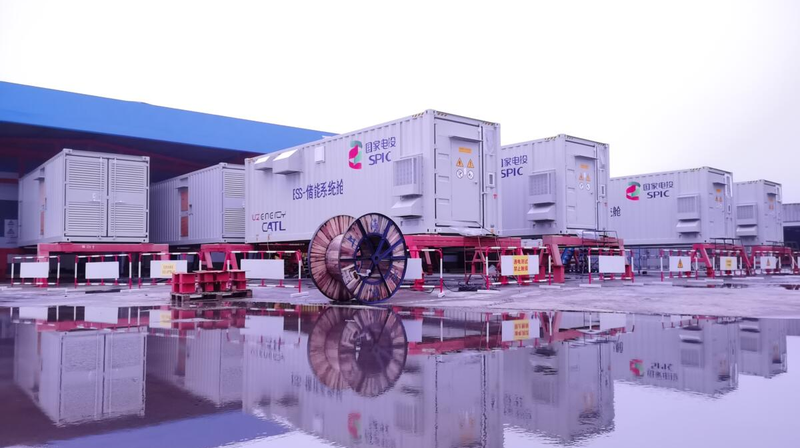
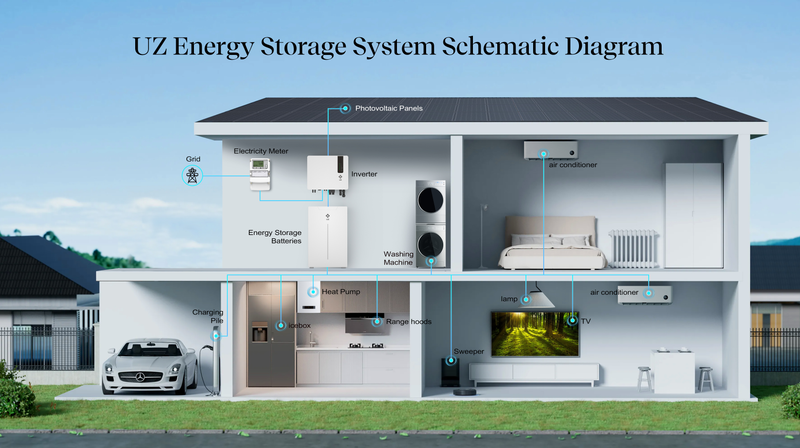
A battery energy storage system (BESS) stores electrical energy in batteries and releases it later when a home, business or power system needs it. The battery cells are only one part of the system. A working BESS also needs equipment to monitor the battery, convert power, control charging and discharging, manage temperature, isolate faults and connect safely to the electrical installation.
That system-level definition matters. A cabinet full of cells can hold energy, but it cannot by itself decide when to charge, convert DC electricity into usable AC power or coordinate with a building or grid.
What components make up a BESS?
The battery is normally organized as cells, modules and larger packs, racks or cabinets. The exact hierarchy varies by product and project, but its purpose is consistent: combine many electrochemical cells into a usable storage block while maintaining monitoring, electrical connection, thermal control and serviceability.
The battery management system (BMS) operates closest to the battery. It measures conditions such as cell voltage and temperature, estimates states such as state of charge, balances cells where the design supports it, communicates battery status and applies protective limits. The BMS does not decide the commercial purpose of the system. Its central responsibility is to keep battery operation within the limits defined for that battery and architecture.
The power conversion system (PCS) controls the electrical conversion between the battery's DC side and the AC side used by most buildings and power grids. During charging, it converts and controls power flowing toward the battery. During discharge, it converts stored DC energy into controlled AC output. Depending on the architecture, related switchgear, relays and isolation functions may sit within or around the PCS.
The energy management system (EMS) coordinates operation at a higher level. It may schedule charging and discharging according to solar production, electricity prices, a facility load profile, a backup reserve or instructions from another control system. The EMS can request an operating point, but that request still has to fit within active battery, converter and site limits.
A complete installation also includes balance-of-system equipment. Pacific Northwest National Laboratory describes an energy storage system as the storage block plus supporting equipment, power equipment, controls and communication, and system integration. Depending on the project, this may include cabling, switchgear, transformers, metering, HVAC, fire protection and a point of connection.
How does a BESS charge and discharge?
Charging begins when electrical power is available from an allowed source, such as the grid or a solar PV system. The PCS controls the conversion and power flow toward the battery. The BMS monitors battery conditions and communicates or enforces the limits that apply at that moment. Energy is stored through reversible electrochemical reactions inside the cells.
When the system discharges, the process runs in the opposite direction. The battery releases DC electrical energy, and the PCS converts it into the form required by the connected AC system. The EMS or another controller determines when discharge is useful, while protection systems continue to supervise whether the requested operation remains allowable.
The process is not perfectly efficient. Energy is lost in the cells, power electronics, cabling and auxiliary systems such as thermal management. This is why energy measured into a BESS will be higher than the energy later delivered from it over the same operating cycle.
The control loop also continues while the system is operating. A discharge request that is feasible at one moment may need to be reduced if battery temperature, state of charge, converter capability or a site constraint changes. The final power output is therefore the result of an operating request constrained by what the battery, PCS and connected system can support.
For a closer look at this control relationship, see How PCS, BMS and EMS Work Together in a BESS.
Power, energy and duration are different specifications
Battery systems are commonly described with both a power rating and an energy rating.
- Power, measured in kilowatts or megawatts, describes how quickly the system can charge or discharge at a given moment.
- Energy, measured in kilowatt-hours or megawatt-hours, describes how much energy the system can store or deliver across time, subject to the stated measurement boundary and operating limits.
A simplified duration can be estimated by dividing usable energy by output power. A system with 200 kWh of usable energy supplying a steady 50 kW load has an idealized duration of four hours. Real operation may differ because auxiliary consumption, conversion losses, reserve settings, changing loads and operating limits reduce or reshape what is available at the point of use.
This distinction explains why a larger energy rating does not automatically make one BESS more capable for every application. A system designed to support a high load for a short period needs a different power-to-energy balance from one designed to serve a smaller load for many hours.
What can a BESS do?
A BESS can shift energy from one time to another. At a solar site, it can charge when generation exceeds immediate demand and discharge later when solar output has fallen. At a commercial facility, it may reduce short demand peaks or coordinate with on-site generation. In a backup-capable installation, it may support selected loads during an outage.
Those applications are not automatic properties of battery capacity. Each depends on the surrounding electrical design, controls and operating agreement. Backup, for example, requires a system that can disconnect appropriately from the grid, establish or follow a suitable local electrical source and supply the selected loads. A battery that is charged when an outage begins is not necessarily configured to power those loads.
A BESS also does not generate energy. It changes when previously supplied energy is available, and every charge-discharge cycle involves losses. Nor does one component guarantee the performance of the whole system. A capable battery cannot compensate for an undersized PCS, an incompatible control interface or a design that does not match the site's load and operating objective.
The most useful way to understand a BESS is therefore as a coordinated electrical system. The battery stores energy, the BMS supervises the battery, the PCS controls power conversion, the EMS coordinates the operating objective, and the balance-of-system equipment connects those functions to a real site. The value of the system depends on how well those elements are designed to perform the job required of them.