Battery capacity determines how much energy can be stored, but control strategy determines when that energy is charged, preserved and discharged. Two identical batteries can therefore deliver different practical results without any difference in hardware.
When two homes install the same 10 kWh battery, it is tempting to expect the same result. Yet the first system may begin discharging as soon as solar production falls below household demand, while the second holds some energy for a higher-price period later in the day. If it is designed and configured for backup, it may also preserve a reserve for an outage.
By early evening, one battery may be close to its reserve level while the other still has energy available. Nothing about their physical capacity is different. They have simply followed different instructions.
Capacity Is Not a Schedule
Capacity, measured in kilowatt-hours, describes how much energy a battery can store. Power, measured in kilowatts, describes how quickly it can deliver that energy. The U.S. Department of Energy treats these as separate specifications because they answer different questions. A battery may hold enough energy to run several appliances over time but still be unable to support them all at once if their combined demand exceeds its power rating.
It also matters which capacity figure is being quoted. Nominal capacity, usable capacity and energy delivered after conversion do not describe exactly the same boundary. The Australian Government’s battery guidance notes that usable capacity is lower than total capacity and that some energy is lost during charging and discharging. Battery figures need to be placed on the same basis before they are compared.
Once those figures are clear, the remaining question is operational: what should the system do with the energy it has?
Why Timing Changes the Result
One of the basic jobs of a home battery is to make electricity available at a different time. A solar system may produce more energy than the home needs around midday, then produce little or nothing after sunset. The battery carries part of that daytime surplus into the evening.
A basic self-consumption mode usually follows what is happening now. When solar production exceeds household demand, the battery charges. When demand rises above solar production, it discharges. This can reduce grid imports, but it may also use stored energy before a more expensive tariff period begins.
A time-based strategy may hold the battery for those later hours. That does not make every kilowatt-hour more valuable in every market; the outcome depends on the tariff and the household’s load pattern. It changes the schedule so that the stored energy is available for a different purpose.
Backup creates another trade-off. In a backup-capable system configured to operate during an outage, a higher reserve leaves more energy available if the grid fails. The same reserve leaves less capacity for everyday self-consumption or tariff management. The Australian Government’s guidance makes this boundary explicit: not every battery system can provide backup, and those that can must be configured for it.
These choices are often described as battery dispatch. They are not separate from capacity, because every decision draws from the same limited store of energy. Energy used in the afternoon cannot still be waiting in the battery that evening.
What “Smart” Control Means in Practice
“Smart control” does not necessarily mean artificial intelligence. A controller can apply a set of rules to information such as solar production, household demand, battery state of charge, reserve settings and electricity prices, then decide whether to charge, discharge or wait.
Some controllers also use forecasts. If strong solar production is expected the next day, a system may allow more energy to be used overnight because another recharge is likely. With a poor forecast, that decision may leave the battery emptier than intended.
Research by Mirletz and Guittet tested a price-responsive dispatch method using solar and load forecasts, battery degradation data and utility rates. Different rates, system sizes, generation and load profiles called for different dispatch strategies. A schedule designed for one tariff or household cannot simply be assumed to fit another.
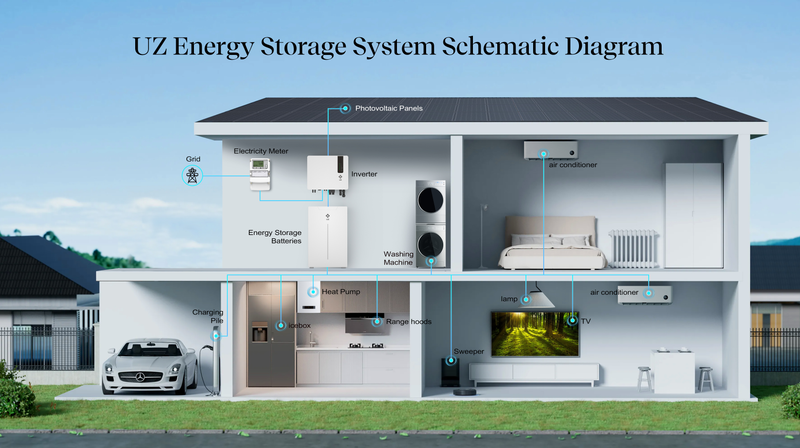
In a more integrated home-energy system, an energy management system, or EMS, may coordinate decisions across solar generation, household loads, the battery, the inverter and the grid connection. A residential study by Merrington, Khezri and Mahmoudi offers one example: its home energy management system used electricity prices, grid constraints, household load and weather data to guide operation. Real systems use different combinations of information, but the purpose is similar—to turn several inputs into one operating plan.
The EMS does not take over the battery’s protective functions. The BMS monitors battery conditions and provides or enforces battery-level operating limits, while the inverter or PCS performs the electrical conversion required for charging and discharging. An EMS request can only be carried out when the battery and power-conversion equipment can support it.
At the hardware level, NXP’s high-voltage battery management unit provides interlock monitoring and contactor control, together with interfaces for communication with an EMS. It is a useful illustration of why site-level coordination does not replace battery protection: the battery layer still needs to restrict or interrupt operation when conditions require it. A more detailed explanation is available in What Does a BMS Actually Do?.
Where Smart Control Stops Helping
If a battery is too small for the intended task, changing its schedule will not remove the energy shortfall. The same applies to power: control software cannot make the equipment deliver more than its rated output.
More complicated control is not automatically better. A systematic review by Azuatalam and colleagues found that increasing the sophistication of an energy-management strategy did not necessarily improve PV-battery performance or economic viability. Modelling assumptions, uncertain input data and the treatment of battery degradation could change the result.
Similar limitations appear in everyday operation. An outdated tariff schedule can move charging to the wrong hours. A reserve set too high may leave useful capacity untouched each day, while one set too low may not reflect the owner’s backup priorities. Forecasts and household routines can change as well, so settings that once made sense may need to be reviewed.
When evening arrives, the useful battery is the one that still has enough energy for the job the household chose. Getting there depends on adequate hardware, sensible settings and an operating strategy that reflects how the home actually uses electricity.